Lore · Ages & Empires
The Elddar and Takish-Hiz
The sand you crossed in the Oasis of Marr was once a forest that covered a quarter of a continent. This is how it died.
Tunare’s first children
Tunare saw a lush forest on a great continent, made a race of elves, and settled them there. They called themselves the Elddar, and they prospered quickly. Their descendants are the high elves and wood elves of today, and Elddar influence can still be seen in their cities.
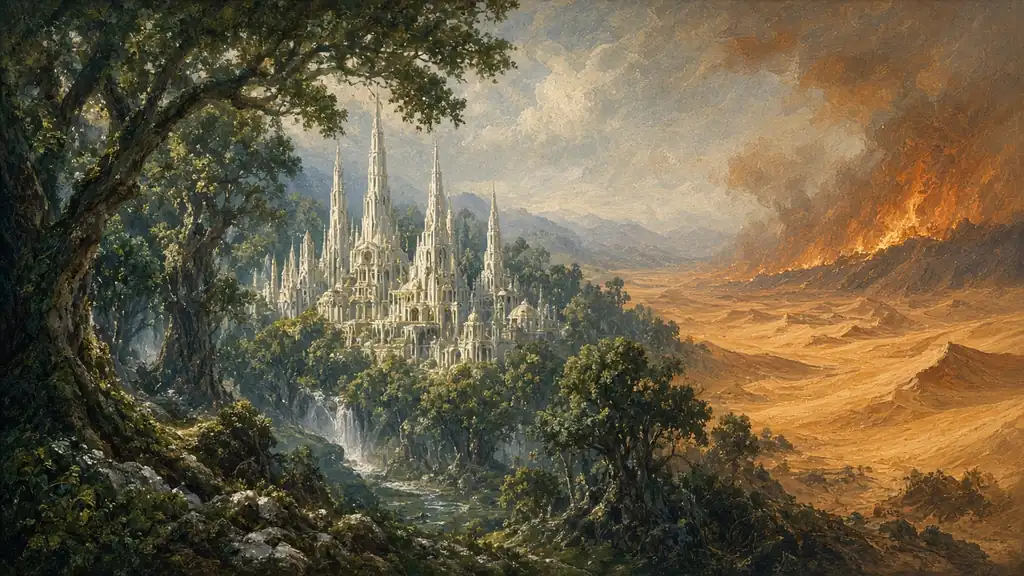
The Elddar Forest spread across the whole southeastern quarter of Tunaria. Wood elves lived in villages high in the trees, and the high elves built marble cities in the clearings, with white towers taller than the tallest trees. At its heart stood Takish-Hiz.
The Tomb of the Crown
To the west, in the Serpent’s Spine, the elves built the tomb and catacombs of Holciel Rowen’dal, which roughly translates as Tomb of the Crown. For hundreds of years the honoured dead were carried there in great processions along the Road of the Dead, and within the tomb each caste had its own place, from commoners up to royalty. So wrote Lyriam Kaelean of the College of High Magic in a 2003 history.
The first theft
Not every god was pleased with Tunare’s children. Innoruuk, left out of the gods’ pact, reached into the halls of Takish-Hiz and stole the first elven king and queen, of the ruling house of Thex. For three hundred years he tore them apart in body and mind, then rebuilt what was left into the first Teir’Dal, the dark elves, and cast them into the underworld of Norrath.
Solusek Ro’s sun
The last of the old empires to fall was the elves’. Solusek Ro, Lord of Flame, arched the spine of the Serpent Mountains and brought the heat of the burning sun down on the forest. Rivers ran dry, and the rain came less every year. The elven druids fought it with all their magic, but they could only slow it. Their scrolls suggest they even created the desert’s giant terrorantulas to defend their lands against the armies of Rallos Zek.
The forest became desert, Takish-Hiz crumbled, and the elves fled Tunaria. So began the Lost Age.
A festival when the world ended
One in-game book gives the fall a single face. Veldyn’s Elven Tale follows Veldyn, an ordinary young Elddar who wove silk and tended the wounded. There was a festival, it says, “the day that the world ended,” with the trees full of glowing wisps.
The ones who stayed
Not every elf fled. Many stayed, believing the forest could still be restored. The sands swallowed hundreds of them, hundreds more were carried to the tomb, and the elves still remembered the path of the Road of the Dead after it was buried. Their experiments to bring Elddar back failed, and their numbers shrank every year.
Then the Teir’Dal came and made war on the home of their ancient enemies. After the defeat of Al’Karad, Takish-Hiz was doomed, and the dark elves slaughtered everyone who could not escape. In Greater Faydark, Niflel Faliwae still tells the story of the elves trapped beneath the sands.
Return to the living city
The city had one more chapter. Much later, in Secrets of Faydwer, Tunare enlisted Karana and Druzzil Ro to send adventurers back in time to the living Takish-Hiz, to recover knowledge for the fight against Mayong Mistmoore.
Where the sources disagree
A later official text says the elves’ prosperity drew Solusek Ro’s jealousy; the original manual simply calls it “the last curse of the gods.”
Sources
[1] Library of Erudin: Elddar Forest · [2] Library of Erudin: “The History of Norrath” (original EverQuest manual text) · [3] Allakhazam: Tunare · [4] Library of Erudin: EverQuest RPG Player’s Handbook: History of Norrath (2002) · [5] Allakhazam: Innoruuk · [6] Allakhazam: Solusek Ro · [7] Library of Erudin: The Fall of Takish-Hiz (EQOA — Chapter 2: Tomb of the Crown)
Keep reading
Retold in our own words from the sources listed on this page; short quotes are marked and sourced. The illustration is an original AI-generated painting made for this page alone, not from the game.