Lore · Ages & Empires
The Iksar Empire
If you ever rolled an iksar, you remember being kill-on-sight in almost every city on Norrath. The iksar have never forgotten why they are alone.
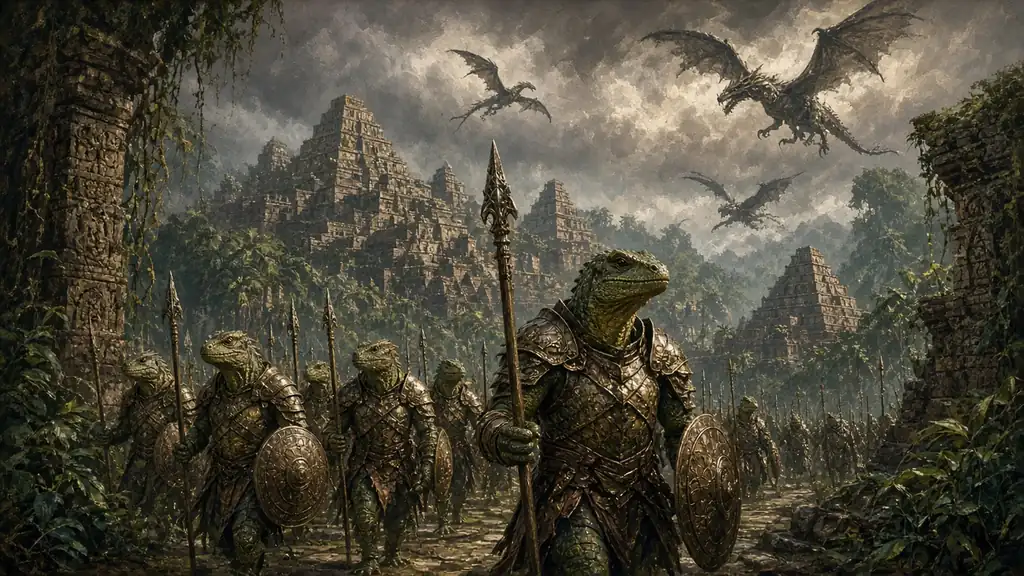
The Age of the Snake
Untold ages ago, the iksar say, Cazic-Thule set them on Kunark, scattered and unlearned. The serpent-like Shissar enslaved them, using them as workers and, in one sage’s telling, as food. From their capital of Chelsith, in what is now the Overthere, the Shissar studied dark rites that would later shape iksar thought.
The plague that spoke
Then the skies opened and the Green Mist came. It formed as a cloud over the Overthere and came down “like a plague from the gods above,” and in its core took shape a face of death that belonged to no god either the iksar or the Shissar knew, speaking in unknown tongues. The Shissar melted away screaming. The iksar were untouched. The Greenmist was “an arcane force all its own,” a developer explained in 2006: not the Avatar of Fear, though gods can speak through it.
Survivors on the moon
Not every Shissar died. T’sharnell, first wizard of Emperor Ssraeshza’s court, left writings about a cure spell that only partly worked. It saved the survivors from the plague by carrying them to the moon of Luclin, and there they raised a dome of magical force and drew all the air from the region except around their new temple, so that the Greenmist could never reach them. Descendants of their iksar slaves still served them there, long after Norrath had decided the Shissar were a myth.
Tribes into an empire
Free at last, the iksar split into rival tribal states and fought one another across Kunark. Some shamans drew power from Cazic-Thule; others dug into the dark arts the Shissar had left behind. It took one warrior-mage of the Kunzar tribe, Venril Sathir, armed with a stolen book of war and necromancy, to bring the tribes under a single banner, willingly or not.
Under Venril the iksar became the Sebilisian Empire, its capital at Sebilis, its shipyards at Viesar and Danak, giant and froglok slaves raising monuments in its name. Its navy was said to be immune to piracy, and free to plunder whomever it liked.
The dragons strike
The empire’s growth frightened the dragons of the Ring of Scale. When Trakanon and some younger dragons sank Emperor Rile Sathir’s ship in a conjured storm, the iksar and the dragons began a war that lasted almost half a century. The Field of Bone, once fertile grassland in the empire’s heart, is its scarred battlefield, and there Ganak, the last of the iksar emperors, killed the great dragon Jaled Dar.
By the time adventurers reached Kunark in 2000, the iksar were rebuilding in Cabilis among the ruins of their own past.
How the iksar remember
Their rites carry their history, as the EverQuest II book Paying Homage to the Past explains. They mark the Green Mist by desecrating something the Shissar made. They honour those slain when Trakanon destroyed Sebilis with a funeral pyre. And they recall their later enslavement in Freeport, which ended when they helped the Overlord crush the Rallosians, by throwing his tools of oppression into the sea. Their hatchlings rarely speak a first word before they begin training for the crusades, and an iksar wears armour to every social occasion.
Where the sources disagree
Shissar or Shissir: one in-game sage’s tale spells the snake people “Shissir.”
How the Green Mist came is told differently by each side: the iksar call it sacred deliverance; the sage says the snake people angered their own gods.
Sources
[1] Allakhazam: Shissar · [2] Library of Erudin: Rise of the Iksar · [3] Library of Erudin: Iksar · [4] Allakhazam: Venril Sathir · [5] Library of Erudin: Sebilisian Empire · [6] Library of Erudin: Ganak (Field of Bone) · [7] Library of Erudin: Trakanon · [8] Allakhazam: Rile Sathir
Keep reading
Retold in our own words from the sources listed on this page; short quotes are marked and sourced. The illustration is an original AI-generated painting made for this page alone, not from the game.